We engineer light.
Optical systems for the next generation of hardware. We design, simulate and tolerance imaging, illumination and photonic systems — from the first requirement to a package your manufacturer can build.
Customers & supporters


Complex optics. Clear engineering decisions.
Space payloads, medical imaging, machine vision and integrated photonics. We connect optical performance to the constraints that decide whether a product can be built: size, tolerance, alignment and cost.
Every optical engineering capability your program needs — in one place.
Component-level design to full system architecture. We don't stop at a pretty simulation: everything we deliver is built to be manufactured.
Custom Optical Design & Analysis
Imaging, relay, projection and laser systems designed from scratch — with full performance evidence: MTF, spot, distortion, throughput.
Stray Light & Ghost Analysis
Scatter modeled through the full assembly; baffles validated and ghosts mapped to 10⁻¹⁴ of signal — before hardware exists.
Tolerancing & Manufacturability
Monte-Carlo budgets and compensator strategy — so the design survives real glass, real mounts, real benches.
Illumination & Laser Systems
Reflex-free illumination, Gaussian beam delivery and fiber coupling — designed with real-world alignment sensitivity, not ideal-bench optimism.
Integrated Photonics & Waveguides
Waveguides, couplers, splitters and resonators — eigenmode and full-wave FDTD design for silicon photonics.
Design Audits & Feasibility
Root-cause audits of underperforming systems and fast feasibility studies — what physics allows, before you commit budget. Most engagements start here.
A process built to kill risk early — and ship optics that work.
- 01
Diagnose
Requirements matrix, assumptions register and first-order feasibility. We tell you what physics allows — and what it will cost — before you spend serious budget.
- 02
Architect
Candidate architectures traded on performance, volume, cost and manufacturability. You choose from quantified options, not opinions.
- 03
Design & tolerance
Full optimization with stray light, thermal and Monte-Carlo tolerance analysis. The as-built performance is predicted, not hoped for.
- 04
Vendor-ready package
ISO 10110 drawings, alignment plan and RFQ package. Clear specifications give fabricators the basis for an informed quote.
- 05
Prototype & production
Vendor evaluation, first-article review, test correlation and design-for-cost iterations through to stable production.
Optics Risk Diagnostic
1–3 weeks. Your problem converted into a requirements matrix, feasibility verdict, risk register and a costed plan — before you commit to a full program.
Build-Ready Design Package
Complete optical design with performance report, tolerance budget, ISO 10110 drawings and a vendor RFQ package. Ready for quotes, not just review.
Engineering Retainer
Reserved senior optical engineering capacity every month: design reviews, vendor support, debugging and analysis on call.
Product Partnership
For optical products with recurring volume: staged NRE, design licensing and royalty structures aligned with your product's success.
Case studies, with numbers.
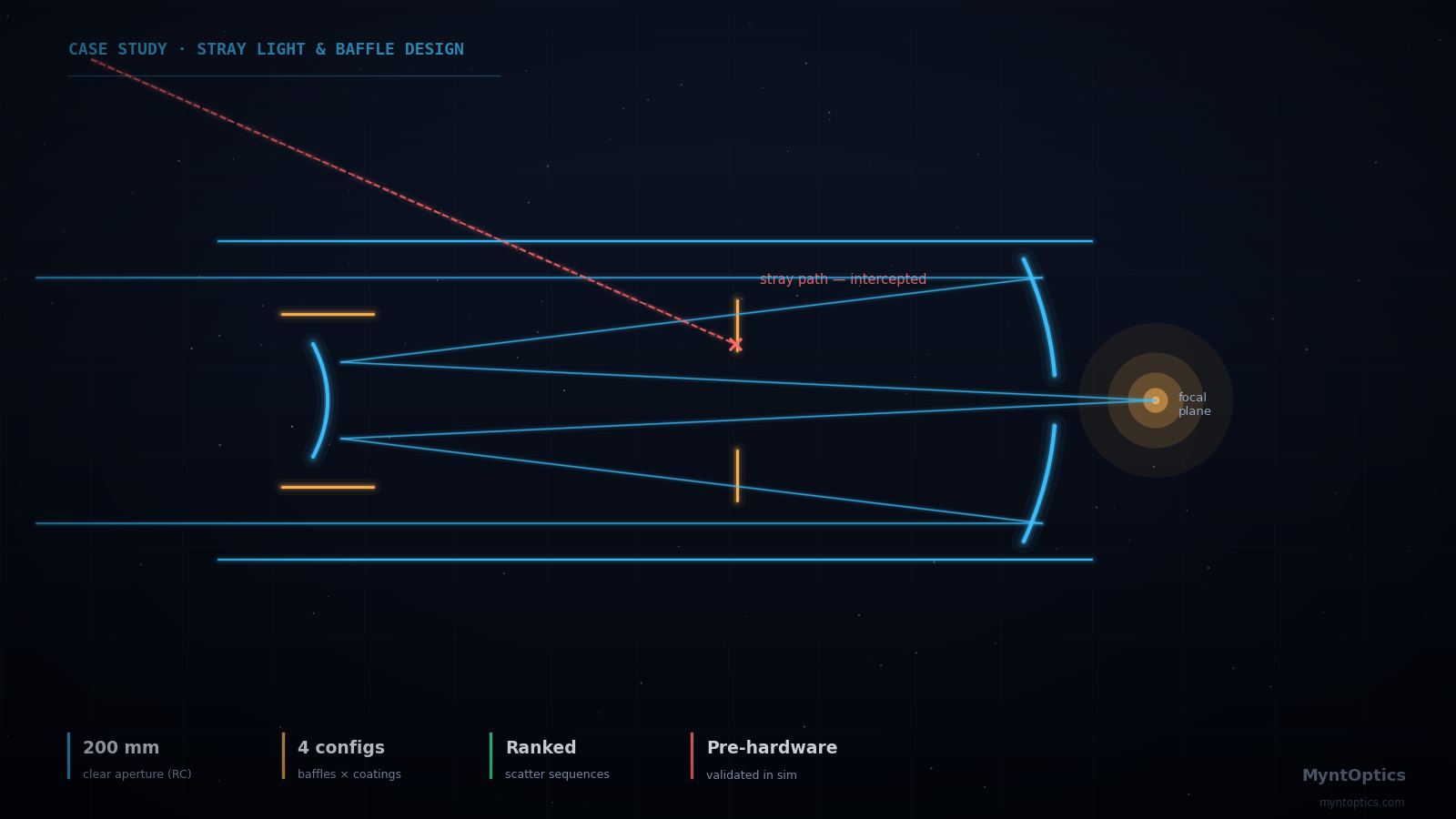
Stray light analysis & baffle design for a high-contrast telescope
4 configs quantified · scatter paths ranked
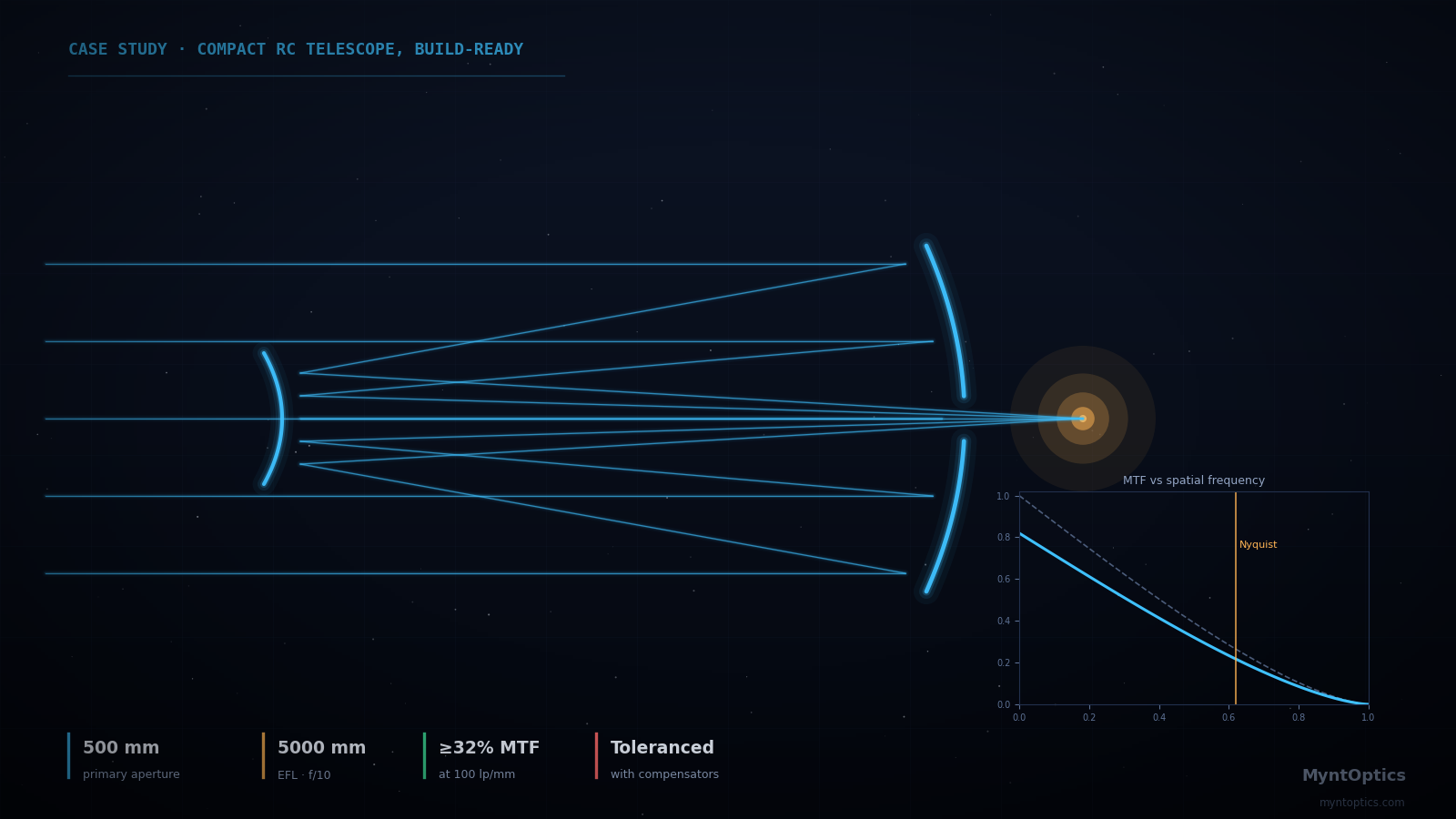
Compact 500 mm RC telescope with full tolerance evidence
5000 mm EFL · MTF + compensator proof
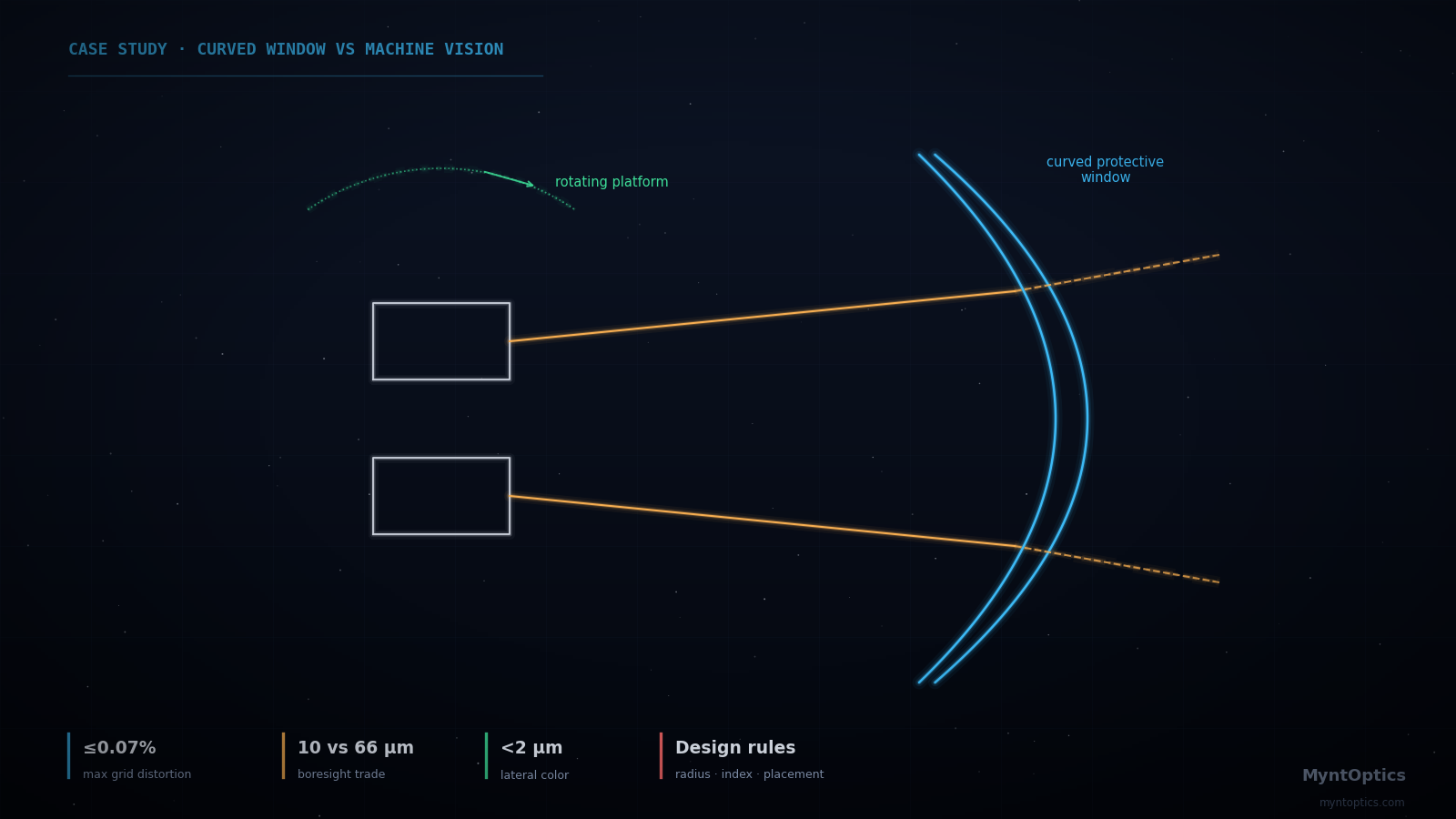
Curved protective window analysis for robotic vision
<0.1% distortion · µm-level boresight
View them all →
Deep domain experience where optics is on the critical path.
Seventeen professional optical calculators. In your browser. Free.
Built by our lens designers on real physics — exact ray tracing, FFT diffraction, eigenmode solving. For quick checks, teaching and early feasibility.
- Metalens & diffractive lens designer, AR waveguide k-space designer, microring resonator designer
- Space laser-comm & datacenter link budgets — full dB waterfalls with turbulence and PAM4 penalties
- Zemax file analyzer, sequential ray tracer, diffraction MTF, Zernike & PSF, Gaussian beams, waveguide modes
- All tools free with your work email

Questions engineers and founders ask us.
What does an optical design consultancy actually deliver?
Working optical systems on paper you can build: requirements matrices, feasibility studies, lens/mirror designs with full performance evidence (MTF, spot size, distortion, throughput, stray light), Monte-Carlo tolerance budgets, ISO 10110 drawings, coating specifications and vendor RFQ packages — plus support through prototyping and production.
Which industries do you serve?
Space and earth observation, defence and electro-optics, medical devices and life sciences, robotics and machine vision, AR/VR, and optics metrology. Recent programs include space telescope payloads, surgical fluorescence oculars, portable fundus cameras, head-mounted displays and precision alignment instruments — see our case studies.
What software and methods do you use?
Zemax OpticStudio for sequential and non-sequential design, Ansys Speos for illumination and stray light, full-vector eigenmode and 3-D FDTD solvers for integrated photonics, and custom Python for analysis and automation. More important than the tools: every design ships with tolerance and manufacturability evidence, not just nominal performance.
How does a project start, and how fast?
Most engagements begin with a fixed-scope Optics Risk Diagnostic (1–3 weeks) that converts your problem into a requirements matrix, feasibility verdict, risk register and a costed next-phase plan. We typically return a proposal within 48 hours of a scoping call. Start here.
Where do you work — can you support our region?
We deliver globally: remote-first collaboration, weekly design reviews, NDA-first engagement and clear IP assignment. Time zones are handled with overlapping working hours agreed at kickoff. Reach us here.
Can you rescue an existing design that underperforms?
Frequently. Our design audit isolates the physics behind the underperformance — aberrations, ghosts, stray light, tolerance stack-up or assembly — and defines a corrected design path. See the UV relay audit case study for an example.
Have optics on your critical path?
Tell us what you're building. We'll tell you what physics allows, what it will cost, and the fastest de-risked route to hardware — usually within 48 hours.